The Ansell Saga
A two year marriage explodes into a twelve year divorce with myriad spin-off litigation spreading through multiple departments.
The divorce proceedings and multiple appeals are ongoing.
Motion to Compel, Kate swim case, Eighth Judicial District Court, A-14-703865-B.
Oct 9, 2026, 3:47 PM
Senior Judge Cynthia Dianne Steel Considers Allowing Camera Access
Alex Falconi, Founding Director;
Oct 8, 2026, 2:25 AM
Our Nevada Judges, Inc., submitted a request to deploy camera access to an impending case management conference in the Ansell divorce. Senior Judge Cynthia Dianne Steel is considering the request.
"An accurate reporting of the Ansell proceedings necessitates comprehensive coverage of an important backdrop of 27 cases, involving over 14 District Court Judges and 16 attorneys across 6 law firms. This is a developing story, and the public's patience is appreciated as coverage unfolds."

Event: The Ansell Saga, Event, 8 minutes, 32 seconds
Coverage will be provided from the Eighth Judicial District Court in the matter of Doug Ansell vs I.A., a Mother. At issue is a twelve year divorce and convoluted cluster of civil cases. You can join as a member by clicking this link here: https://www.youtube.com/channel/UCJPb0hCUcufpuk7QhxVxwKA/join For inquiries, feel free to contact us through www.ournevadajudges.com
Calendar Call, Kate swim case, Eighth Judicial District Court, A-14-703865-B.
Sep 1, 2016, 8:45 AM
Motion to Compel, Kate swim case, Eighth Judicial District Court, A-14-703865-B.
Jul 7, 2016, 8:30 AM
Joinder, Kate swim case, Eighth Judicial District Court, A-14-703865-B.
Jun 21, 2016, 8:30 AM
Motion Hearing, Kate swim case, Eighth Judicial District Court, A-14-703865-B.
Jun 21, 2016, 8:30 AM
Status Check, Kate swim case, Eighth Judicial District Court, A-14-703865-B.
May 26, 2016, 8:30 AM
Ansell Files Verified Petition to Terminate Offender Registration Duties
Felony case, Eighth Judicial District Court, 98C149438, Offender Registration Hearing, Jun 16, 2015, 8:30 AM
Maren Barney, Legal Reporter;
Jun 16, 2015, 9:00 AM
In April 2015, Doug Ansell, represented by a new attorney, Margaret A. McLetchie, Esq., filed a verified petition seeking to terminate his sex offender registration duties. It asserted that he had been classified as a low-risk Tier I offender since his initial registration and had complied with the legal requirements imposed during his probation. The petition also asserted that Ansell was not a danger to anyone and did not pose a threat to the safety or well-being of others. District Court Judge Michael Villani scheduled a hearing for June 16, 2015. No one appeared. The minute entry stated: "Since no one is present, Court Ordered, Matter is OFF CALENDAR." Ansell does not appear in any searches of the Nevada Department of Public Safety's Sex Offender Registry.
Motion for Protective Order, Kate swim case, Eighth Judicial District Court, A-14-703865-B.
Apr 16, 2015, 8:30 AM
Motion Hearing, Kate swim case, Eighth Judicial District Court, A-14-703865-B.
Feb 10, 2015, 8:30 AM
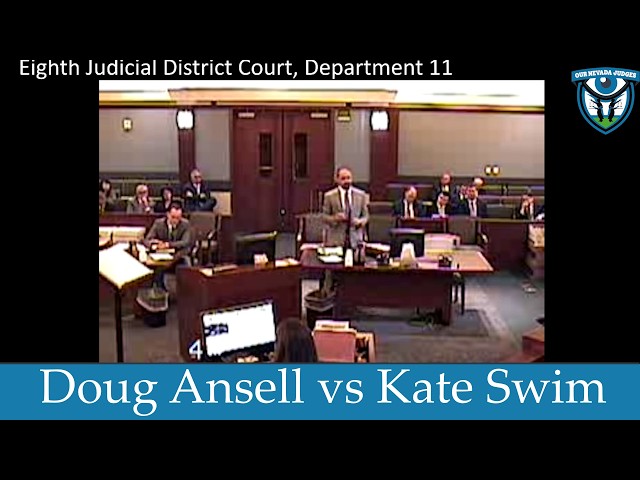
Doug Ansell vs Kate Swim, Hearing, 19 minutes, 18 seconds

Presiding
The Honorable Betsy Gonzalez, Eighth Judicial District Court, presiding over a motion hearing. Attorney Jeff Hall appeared on behalf of Mr. Ansell. Attorney James Smyth appeared on behalf of Ms. Bruening. Case No. A-14-703865-B. The Court orders pleadings amended. You can join as a member by clicking this link here: https://www.youtube.com/channel/UCJPb0hCUcufpuk7QhxVxwKA/join For inquiries, feel free to contact us through www.ournevadajudges.com
Settlement Conference, Kate swim case, Eighth Judicial District Court, A-14-703865-B.
Jan 30, 2015, 10:30 AM
, , , .
Ansell's Challenge of Sex Registration Requirements Fails
Felony case, Eighth Judicial District Court, 98C149438, Offender Registration Hearing, Oct 4, 2012, 8:15 AM
Maren Barney, Legal Reporter;
Oct 10, 2012, 9:00 AM
On October 10, 2012, the court entered Findings of Fact, Conclusions of Law, and an Order denying Doug Ansell's petition for post-conviction relief.
State Argues Ansell's Re-Classification To Tier 2 Offender Requires 25 Years of Registration
Felony case, Eighth Judicial District Court, 98C149438, Offender Registration Hearing, Sep 18, 2012, 8:15 AM
Felony case, Eighth Judicial District Court, 98C149438, Offender Registration Hearing, Sep 27, 2012, 8:15 AM
Maren Barney, Legal Reporter;
Sep 27, 2012, 9:00 AM
The State filed a reply to Doug Ansell's challenge of his sex offender registration requirements on September 7, 2012. It disputed Ansell's interpretation of the applicable statutory scheme and argued that, once the relevant injunction was lifted, Ansell would be classified as a Tier II offender based on his conviction. Under the statutory framework cited by the State, that classification would require 25 years of registration without the ability to petition for relief. The State also argued that Ansell's alternative request to set aside his conviction was barred by the law-of-the-case doctrine because the issue had already been presented to and decided by the court.
Ansell Challenges Sex Offender Registration Requirements, State Files Opposition
Felony case, Eighth Judicial District Court, 98C149438, Offender Registration Hearing, Aug 16, 2012, 8:15 AM
Maren Barney, Legal Reporter;
Aug 16, 2012, 9:00 AM
After losing his effort to set aside the conviction, Doug Ansell turned his attention to another consequence of that conviction: his offender-registration requirements. In August 2012, Ansell filed a petition to reduce his sex offender registration period. Through Defense Attorney Craig Mueller, he argued that he had complied with all requirements associated with his conviction and had been registered and supervised since July 7, 1998. Mueller argued that Ansell had completed his probation, supervised release, and required counseling and had otherwise satisfied the requirements for relief under NRS 179D.490. The State then opposed the petition. It argued that the version of Chapter 179D on which Ansell relied had been stayed and that the earlier statutory provisions remained applicable. The State therefore argued that Ansell was not eligible to have his registration period reduced. Ansell responded on August 24, 2012. He argued that the State was attempting to apply an older version of NRS 179D.490 that required fifteen years of registration rather than the ten-year period provided by the newer statute. Mueller maintained that Ansell qualified as a Tier I offender, had satisfied the applicable requirements, and had experienced no subsequent incidents. He argued that Ansell should therefore be permitted to terminate his registration obligations.
Motion Denied, Ansell's Conviction Legally Possible
Felony case, Eighth Judicial District Court, 98C149438, Motion to Set Aside, Jan 13, 2011, 8:15 AM
Maren Barney, Legal Reporter;
Jan 31, 2011, 9:00 AM
The dispute over whether Doug Ansell's conviction was a legal impossibility ultimately came before the court on January 13, 2011. District Court Judge Michael Villani rejected Ansell's argument and denied the motion. The court stated that it disagreed with Defense Attorney Craig Mueller's position and found that there was ample evidence that photographs existed. The court also noted the significance of the plea agreement and the State's agreement not to file additional charges. An order formally denying the motion was filed on January 31, 2011.
The State Strikes Back, Additional Information Significant, Court Sets Hearing
Felony case, Eighth Judicial District Court, 98C149438, Motion to Set Aside, Dec 16, 2010, 8:15 AM
Maren Barney, Legal Reporter;
Dec 8, 2010, 9:00 AM
In a December 2010 supplemental filing, the State disputed Doug Ansell's characterization of the underlying evidence supporting his conviction. The State asserted that the photograph had been recovered from the victim's computer and that the victim had identified herself in the photograph and recalled that it had been taken when she was fifteen. The State also presented allegations concerning additional photographs and other evidence it claimed had been uncovered during the investigation. According to the State, the victim reported that Ansell had taken pornographic photographs of her on approximately 30 to 40 occasions between the ages of thirteen and sixteen. The State further asserted that the plea negotiations had accounted for the possibility of substantially more serious charges arising from the investigation. The State maintained that Ansell had been aware of the extent of the investigation when he entered his plea and that the plea agreement included an understanding that additional charges would not be filed. If Ansell sought to withdraw his guilty plea, the State indicated that it anticipated pursuing additional charges based on the investigation. Defense Attorney Craig Mueller disputed the State's account. In supplemental briefing filed January 7, 2011, he argued that the State's additional allegations were based primarily on recorded statements from the victim and her father. He asserted that the search warrant had produced only one photograph, rather than the 30 to 40 photographs referenced by the State, and emphasized that Ansell had been charged with only one count. Mueller also argued that a defendant could plead guilty while maintaining his innocence through an Alford plea.
Court Indicates Inclination To Set Aside Conviction
Felony case, Eighth Judicial District Court, 98C149438, Motion to Set Aside, Oct 26, 2010, 8:15 AM
Felony case, Eighth Judicial District Court, 98C149438, Motion to Set Aside, Nov 4, 2010, 8:15 AM
Felony case, Eighth Judicial District Court, 98C149438, Motion to Set Aside, Nov 18, 2010, 8:15 AM
Maren Barney, Legal Reporter;
Nov 18, 2010, 9:00 AM
Doug Ansell's efforts to challenge his conviction continued through the fall of 2010. After the court continued the matter because of the late filing of the State's opposition, Defense Attorney Craig Mueller filed a reply arguing that equitable laches did not apply. He maintained that an illegal sentence could be corrected at any time under NRS 176.555 and argued that Ansell's constitutional rights outweighed any burden the State would face from revisiting the conviction. District Court Judge Michael Villani continued the hearing again in November while it considered the parties' arguments and sought additional information. On November 10, Judge Villani indicated that it was inclined to grant Ansell's motion but wanted additional information before making a final decision.
Twelve Years Later, Ansell Challenges Conviction
Maren Barney, Legal Reporter;
Oct 26, 2010, 9:00 AM
In October 2010, more than twelve years after his conviction, Doug Ansell returned to court with a new argument: he claimed that the factual basis for his guilty plea had been legally impossible. Through Defense Attorney Craig Mueller, Ansell filed a motion to set aside his conviction. Mueller argued that the alleged victim had actually been over sixteen years old when the photograph underlying the conviction was taken. According to the motion, the victim had been born in September 1981 and was sixteen years, two months, and six days old when the photograph was taken on December 13, 1997. Mueller therefore argued that the conviction, which was based on the allegation that the victim was under sixteen, rested on a materially false factual premise and that Ansell had pleaded guilty to a legal and factual impossibility. The State opposed arguing that Ansell was not entitled to relief under Hargrove v. State and that his request was also barred by equitable laches. The State emphasized that Ansell's conviction had been entered more than twelve years earlier and argued that he had offered no adequate explanation for waiting so long to challenge it. The State maintained that the facts underlying his argument had been available to him when he entered his plea.
Ansell Urges Release From Residential Confinement
Felony case, Eighth Judicial District Court, 98C149438, Motion for Release, Mar 29, 2001, 9:00 AM
Felony case, Eighth Judicial District Court, 98C149438, Evidentiary Hearing, Apr 5, 2001, 9:00 AM
Felony case, Eighth Judicial District Court, 98C149438, Evidentiary Hearing, Apr 12, 2001, 8:30 AM
Felony case, Eighth Judicial District Court, 98C149438, Evidentiary Hearing, Apr 19, 2001, 10:00 AM
Felony case, Eighth Judicial District Court, 98C149438, Status Check, May 29, 2001, 9:00 AM
Maren Barney, Legal Reporter;
Mar 15, 2001, 9:00 AM
In March 2001, Doug Ansell asked the court to release him from residential confinement. His motion stated that he had complied with the terms of his probation and residential confinement and had appeared whenever required by the court. He argued that the confinement had also significantly affected his employment. At the time, Ansell worked for a day-trading firm and served as a system administrator responsible for web servers, domain controllers, and DNS servers.
Ansell Enters Alford Plea, Convicted, Sentenced to Probation
Felony case, Eighth Judicial District Court, 98C149438, Sentencing, Jun 9, 1998, 9:00 AM
Felony case, Eighth Judicial District Court, 98C149438, Sentencing, Jul 7, 1998, 9:00 AM
Felony case, Eighth Judicial District Court, 98C149438, Motion Hearing, Apr 29, 1999, 9:00 AM
Felony case, Eighth Judicial District Court, 98C149438, Motion for Release, Jun 1, 2000, 9:00 AM
Felony case, Eighth Judicial District Court, 98C149438, Intent to Revoke Probation, Jun 5, 2000, 9:00 AM
Felony case, Eighth Judicial District Court, 98C149438, Motion to Set Bail, Jun 13, 2000, 9:00 AM
Felony case, Eighth Judicial District Court, 98C149438, Motion to Set Bail, Jun 19, 2000, 9:00 AM
Felony case, Eighth Judicial District Court, 98C149438, Motion to Set Bail, Jun 20, 2000, 9:00 AM
Felony case, Eighth Judicial District Court, 98C149438, Motion to Rehear, Aug 14, 2000, 9:00 AM
Felony case, Eighth Judicial District Court, 98C149438, Motion to Rehear, Aug 31, 2000, 8:15 AM
Felony case, Eighth Judicial District Court, 98C149438, Motion to Rehear, Sep 5, 2000, 8:15 AM
Felony case, Eighth Judicial District Court, 98C149438, Motion to Rehear, Sep 12, 2000, 8:15 AM
Felony case, Eighth Judicial District Court, 98C149438, Status Check, Oct 30, 2000, 9:00 AM
Felony case, Eighth Judicial District Court, 98C149438, Status Check, Dec 21, 2000, 9:00 AM
Felony case, Eighth Judicial District Court, 98C149438, Status Check, Dec 28, 2000, 9:00 AM
Felony case, Eighth Judicial District Court, 98C149438, Status Check, Jan 16, 2001, 9:00 AM
Maren Barney, Legal Reporter;
Jul 24, 1998, 9:00 AM
On July 24, 1998, a Judgment of Conviction was filed, reflected that Doug Ansell had pled guilty to Possession of a Visual Presentation Depicting Sexual Conduct of a Person Under Sixteen Years of Age, a Category B felony. The court imposed a sentence of 16 to 40 months but suspended the sentence and placed Ansell on probation for up to three years. Among the conditions were sex-offender counseling, restrictions on contact with the victim and minors under sixteen, a $2,500 fine, payment of the cost of a psychosexual examination, monthly community service if required, and additional monitoring requirements. In 1999, District Court Judge Jeffrey Sobel modified the community-service requirement. An amended judgment provided that Ansell was not required to perform community service while employed full-time, but would be required to complete community service if he was not employed full-time.
Ansell Charged on Recording Child Sexual Performance, Waives Preliminary Hearing
Felony case, Eighth Judicial District Court, 98C149438, Initial Arraignment, Apr 8, 1998, 9:00 AM
Felony case, Eighth Judicial District Court, 98C149438, Arraignment Continued, Apr 9, 1998, 9:00 AM
Maren Barney, Legal Reporter;
Apr 8, 1998, 9:00 AM
In February 1998, Douglas Ansell was arrested by the Las Vegas Metropolitan Police Department after a warrant was issued alleging that he had committed two felony offenses involving a minor. The charges were Use of a Minor in Producing Pornography and Possession of a Visual Presentation Depicting Sexual Conduct of a Person Under Sixteen Years of Age. The following day, the State filed a criminal complaint in the Henderson Justice Court, which docketed under case number 98FH1518X. The complaint alleged that Ansell had used or permitted a minor to engage in sexual conduct for the purpose of producing a pornographic performance and had recorded the performance. It also alleged that Ansell possessed photographic or other visual material depicting a person under sixteen years of age engaged in sexual conduct.
Ansell appeared before the on February 5, 1998. He waived the reading of the complaint and, through counsel, waived the fifteen-day rule and requested a date certain for the



©2026 Our Nevada Judges, Inc.
Terms & ConditionsVersion: 5.2.8Privacy Policy
An NRS Chapter 82 non-profit corporation. Recognized by the IRS as a Section 501(c)(3) organization.